
The 40/40/20 workforce needed an operating system. So we built Mobilise.

By

Rich Wilson
October 7, 2026

In August 2026 we published The 40/40/20 Workforce. Since then I have had the same conversation with CIOs and CTOs dozens of times. They agree with the model. They cannot run it.

The reason is simple. The team a technology leader runs today looks nothing like the one they ran two years ago. AI agents now sit alongside engineers and take on real delivery work. Yet the way that team is tracked has barely changed. Skills live in spreadsheets that are out of date within a quarter. Agents are adopted faster than anyone can log them.

So when a new project lands, the safest option is to look outside. Enterprises end up paying professional services firms for work their own people and agents could have delivered. Or at least delivered some of it.

However, I know from my time at Gartner that a model without a mechanism is just a slide. This month we launch Mobilise by Gigged.AI, the work orchestration platform that brings 40/40/20 into the enterprise.

What 40/40/20 actually says

The 40/40/20 Workforce Model is a target blend for technology teams:

  • 40% full-time employees. The people who hold your context, your culture and your accountability.
  • 40% on-demand specialists. Contractors, fractional leaders, freelancers and SOW consultants, brought in for a defined outcome.
  • 20% AI agents. Digital workers that take on repeatable tasks and free your engineers for higher-value work.

The ratio is a direction of travel, not a quota. The principle underneath it matters more which is internal first. We started this platform as an Internal Talent Marketplace but we realised last year that Work Orchestration is the next step as companies need to use the people and agents you already have before you spend a pound outside. Only then fill the genuine gaps, and fill them with a specialist for the exact skill missing rather than a team of twelve.

Why a book was not enough

Three gaps came up in almost every conversation after the book.

  1. No one knows what they already have. Most enterprises cannot list the skills in their technology function, let alone the agents. You cannot go internal first if you cannot see internal.
  2. Work is still planned in roles, not tasks. A project brief becomes a headcount request. Nobody asks which tasks need a senior engineer, which need a specialist for six weeks and which an agent could do tonight.
  3. Agents are ungoverned. Business units build their own with multiple vendors. Central leadership loses oversight, and tools that were bought sit idle.

None of these is a strategy problem. They are operating problems, and operating problems need software.

How Mobilise works

Mobilise sits between the outcome an enterprise wants and the talent that delivers it.
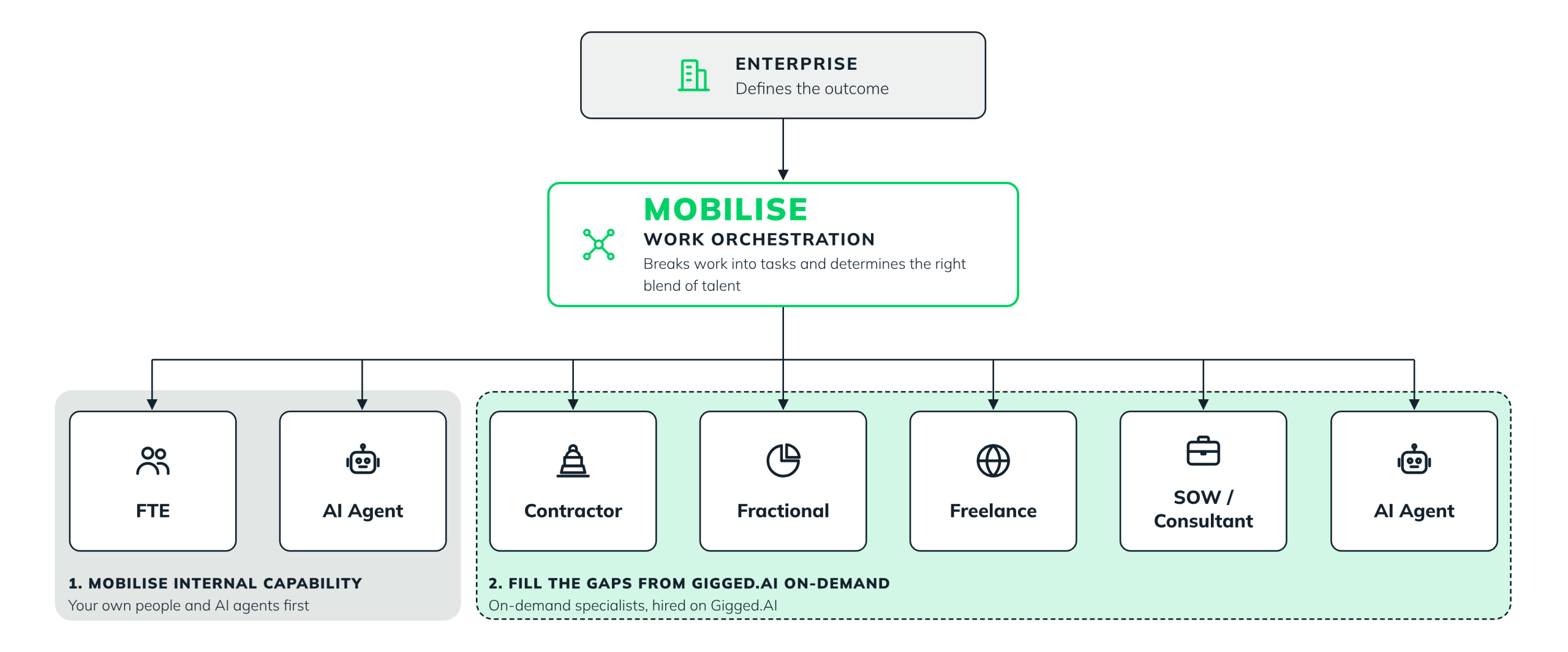
The flow has three steps:

  1. The enterprise defines the outcome using our triage agent. A project brief, not a headcount request.
  2. Mobilise breaks the work into tasks and determines the right blend of talent for each one, matched against a taxonomy of 40,000+ technology skills.
  3. Internal capability is mobilised first. Your own FTEs and your own AI agents. Only where a gap remains does Mobilise fill it from Gigged.AI On-Demand: a contractor, a fractional leader, a freelancer, an SOW consultant or a pre-built agent from our library.

That order is the whole point. It is the internal-first principle from the book, written into the product.

Map, Measure, Mobilise

Each of the three gaps has a matching capability.

  • Map closes the visibility gap. One inventory of every human skill and every AI agent across your technology function, in a common language. Agents running in Copilot, Claude, ServiceNow, Salesforce and your own builds sit in the same registry as your engineers.
  • Measure closes the governance gap. Real-time dashboards on utilisation, skills gaps and agent deployment show where AI adoption is real and where tools sit unused. It also works inside the assistants your teams already use, including Copilot, Claude and ChatGPT.
  • Mobilise closes the planning gap. A project brief becomes a costed, staffed team in seconds, built from roles, skills and tasks, and pushed to Jira ready for kick-off.

It is built for the people who own delivery: CIOs and CTOs, their heads of department, and the programme directors and PMO leads who need a team standing before the project clock starts.

Conclusion

Most enterprises do not have a skills shortage. They have a visibility shortage, and they are paying professional services rates to cover it.

The winners of the human-AI shift will not be the organisations with the most engineers or the most agents. They will be the ones that know exactly what they have and can put it to the right work on the same day.

The book set out the model. Mobilise is how you run it.

Take the tour or see Mobilise in full. Mobilise is also available through Microsoft Marketplace.

Hire faster. Spend less. Deliver more.

Gigged.AI helps enterprise technology leaders map skills, mobilise their people & AI agents and fill critical gaps with on-demand talent.

How can we help?

For Enterprises

I need to hire a contractor for a project

Hire vetted developers, data scientists, AI specialists and more in days. Use outcome-based or T&M SoWs to keep projects moving without adding permanent headcount.

For Enterprises

I need to deploy the right skills and agents to projects

Map every skill and agent in your function to a comprehensive framework. See real-time capability and deploy teams to projects faster.

For Contractors & Freelancers

I'm looking for my next gig

Join 25,000+ freelancers using Gigged.AI to find remote work with global enterprises. Create a free profile, get matched to gigs automatically and get paid securely.

Something else? Please submit your contact details using this form and we’ll be in touch.